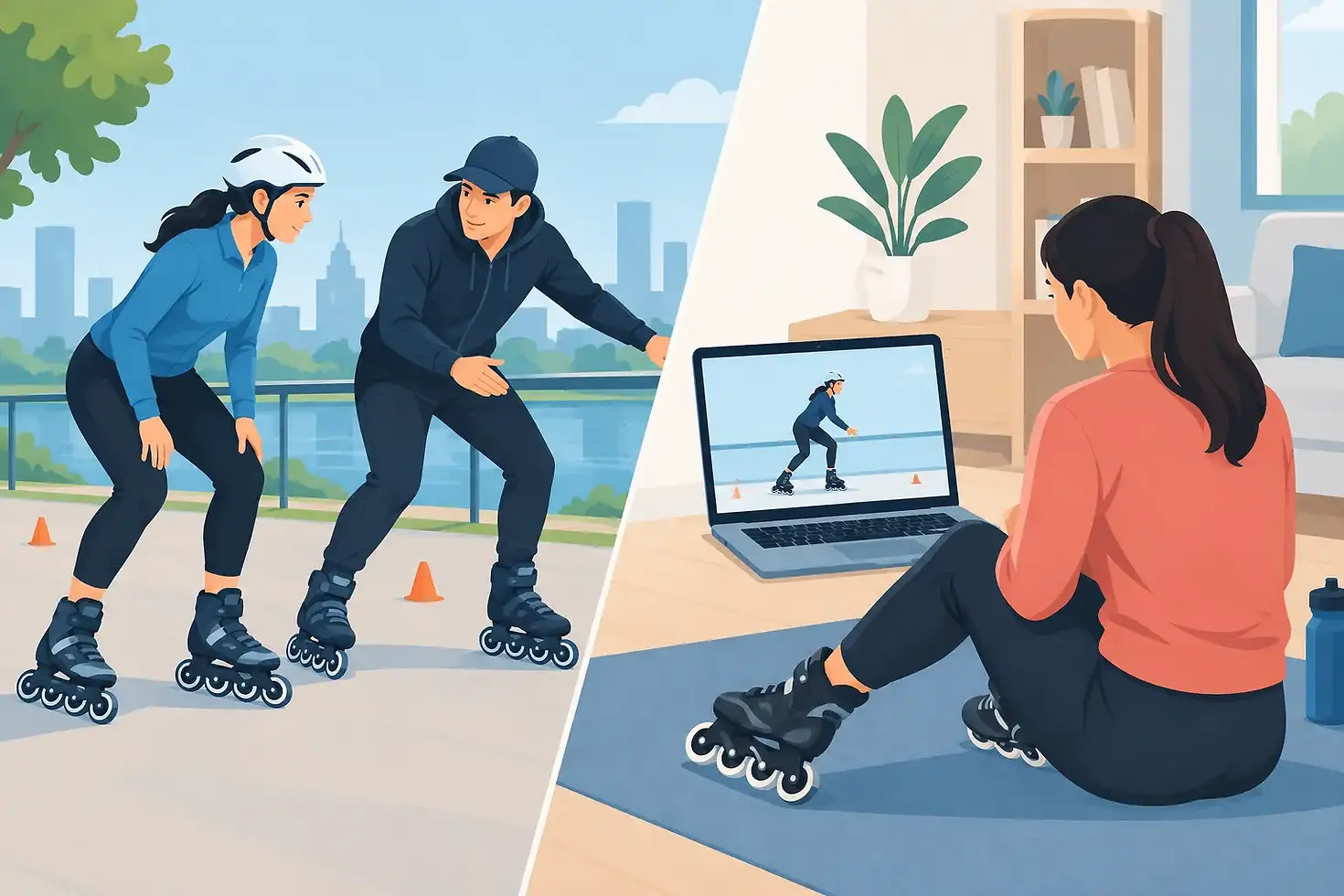
Professional Coach Versus Online Tutorials

A child watches a skating video, stands up with enthusiasm, and then freezes the moment the wheels begin to roll. An adult may have the opposite experience: they can move a few meters, but every turn feels tense and every slope looks risky. This is where the choice between a professional coach versus online tutorials becomes more than a question of convenience. It shapes how safely and confidently a new skater learns.
Online videos can be a useful source of inspiration. They make skating look accessible and can introduce basic ideas before a first lesson. But skating is a moving skill. Balance, posture, braking, falling, and turning all happen quickly, and small mistakes can become habits before a beginner realizes anything is wrong.
For families and adults deciding how to begin, the best option depends on the learner's goals, confidence, and need for personal guidance. Here is what changes when instruction is built around the person wearing the skates.
Professional Coach Versus Online Tutorials: The Real Difference
The main difference is not simply that one option costs money and the other may be free. It is feedback.
A tutorial gives the same instructions to every viewer. A coach observes how one learner stands, shifts weight, reacts to speed, and responds after a wobble. That coach can make an immediate adjustment: bend the knees more, look ahead instead of down, keep the feet slightly wider, or slow the pace before fear takes over.
Those details matter because inline skating is rarely difficult for just one reason. A child may struggle because they are stiffening their legs. Another may understand the movement but become distracted in a busy park. An adult may have enough strength but hesitate to commit their weight to one foot. A video cannot tell which issue is getting in the way. A trained instructor can.
This does not mean tutorials have no place. They can help learners revisit a familiar skill, see a drill again, or stay motivated between sessions. They work best as a supplement after a skater has learned sound fundamentals, rather than as the only plan for a complete beginner.
Safety Starts Before the First Glide
Many online skating lessons focus on the exciting part: rolling forward. A good beginner program begins earlier, with equipment checks, a safe practice area, and clear expectations for how to fall.
Learning to fall safely is not a sign that a student will fail. It is one of the skills that makes progress possible. When beginners know how to use knee pads, wrist guards, and protective gear correctly, they are less likely to panic when balance shifts. They can get up calmly and try again.
A professional coach also chooses drills in an order that protects confidence. First comes stable standing, then marching steps, controlled gliding, stopping, turning, and awareness of the skating environment. Rushing ahead to speed or tricks can feel exciting, but it creates unnecessary risk when stopping control is still weak.
For parents, supervision is a major consideration. Children often have the energy to keep trying long after their technique begins to fade. In a small group or private lesson, an instructor can spot fatigue, refocus attention, and make the activity challenging without letting it become overwhelming. This is especially valuable for shy children, energetic children, and those who need more time to trust their body on wheels.
Structure Turns Practice Into Progress
Watching ten different videos can create the impression of learning without a clear route forward. One creator may teach turns before stops, another may recommend a stance that conflicts with the previous video, and a third may be speaking to intermediate skaters rather than true beginners.
A structured curriculum removes that guesswork. Each lesson has a purpose, and each skill prepares the learner for the next one. Skaters build balance before speed, stopping before more advanced movement, and confidence before complex drills.
At Affinity Skates, the progressive six-level curriculum gives learners a visible path from first standing exercises to stronger all-around control. This can be reassuring for parents who want to see more than a fun afternoon, and for adults who want to know what they are working toward.
Structure also makes practice more productive. Instead of skating around and hoping to improve, a learner can spend ten focused minutes on one drill with a clear goal. For example, they might practice a controlled glide with soft knees, then repeat a simple stop until it feels reliable. Short, purposeful practice is often more effective than a long session of repeating mistakes.
The Confidence Factor Is Personal
The biggest obstacle for many beginners is not fitness. It is the feeling that they might fall in front of other people.
Tutorials can be appealing because they allow learners to practice privately. For someone who feels self-conscious, that privacy is a real benefit. Yet it can also make it easier to stop after the first difficult attempt. Without reassurance, a normal wobble may feel like proof that skating is not for them.
A patient coach helps learners recognize that wobbling is part of the process, not a verdict on their ability. They can scale an exercise down, celebrate a small improvement, and bring the learner back to a successful step before progressing. Children benefit from games that make repetition feel enjoyable, while adults often appreciate calm explanations of what their body should be doing and why.
The right coaching environment does not push every student at the same pace. Some learners gain confidence quickly and need fresh challenges. Others need a few more repetitions before they are ready to glide independently. Personal pacing helps both groups progress with less frustration.
When Online Tutorials Can Be Useful
Online tutorials are most helpful when they support, rather than replace, hands-on learning. They are a practical choice for reviewing a technique already introduced by a coach, understanding skate maintenance, or finding simple practice ideas for a quiet session.
They may also suit experienced skaters who already have strong foundations and can assess whether a new exercise is appropriate for their ability. Even then, it is wise to choose a flat, open area, wear full protective gear, and avoid practicing unfamiliar skills alone.
For a complete beginner, however, tutorials leave several unanswered questions: Is my stance safe? Am I using the brake correctly? Why do I keep rolling backward? Is this surface suitable? Those questions are not minor. They are often the difference between a learner who continues and one who puts the skates away after a painful or discouraging first try.
Choosing the Right Start for Your Family or Yourself
If the goal is simply to see whether skating looks fun, a few age-appropriate videos can create excitement before a trial class. But if the goal is to build real control, safety habits, and confidence, personal instruction offers a stronger foundation.
Look for coaches who can explain their progression, teach safe falling and stopping early, work with the learner's age and comfort level, and provide individual attention. Certified instruction matters because beginners need more than encouragement. They need someone who understands how to identify risk, correct movement, and teach skills in a sensible sequence.
Flexible lesson formats can make this easier to fit into family life. A private lesson may suit a nervous first-timer or a learner with specific goals. Small group classes can add social motivation while still allowing for guidance. A trial class is often the simplest way to see which setting helps a child, teen, or adult feel ready to learn.
The first skating session does not need to be dramatic. A learner who finishes feeling stable, safe, and willing to return has made the kind of progress that lasts. Give that first experience the patience and guidance it deserves, and the next glide can become the beginning of a healthy, confident lifelong activity.


Comments