How to Turn on Skates Safely for Beginners

A turn can feel harder than rolling forward because your body has to balance, steer, and control speed at the same time. Learning how to turn on skates is not about twisting your feet quickly. It is about using a stable stance, looking where you want to go, and making small movements you can control.
For children, teens, and adults, turning becomes much easier once the basics are in place. Start on smooth, dry, level ground with plenty of open space. Wear a certified helmet, wrist guards, knee pads, and elbow pads every time you practice. A confident turn begins before you move: with the right safety gear, enough room, and a pace that does not feel rushed.
Build the skills that make turning safer
Before practicing turns, make sure you can stand still on skates, roll forward slowly, and stop with control. If you cannot stop yet, stay with gentle curves rather than trying tight turns. Turning while moving too fast is one of the most common reasons beginners lose balance.
Use a relaxed skating stance. Keep your knees bent, chest lifted, and arms slightly forward and out to the sides. Your feet should be about hip-width apart, not tightly together. This low, athletic position gives you room to shift your weight without tipping backward.
Your eyes matter more than many beginners expect. Do not stare down at your skates. Look ahead, then turn your head and shoulders gently toward the direction you want to travel. Your body naturally follows your gaze. Looking at an obstacle, a curb, or the ground often pulls your balance toward it.
It also helps to understand the inside and outside edges of your skates. When you lean very slightly into a curve, the wheels on the inside edge of the skate help guide you around it. This is a subtle weight shift, not a dramatic lean. Keep your upper body centered over your skates rather than dropping a shoulder toward the ground.
How to turn on skates with wide, gentle curves
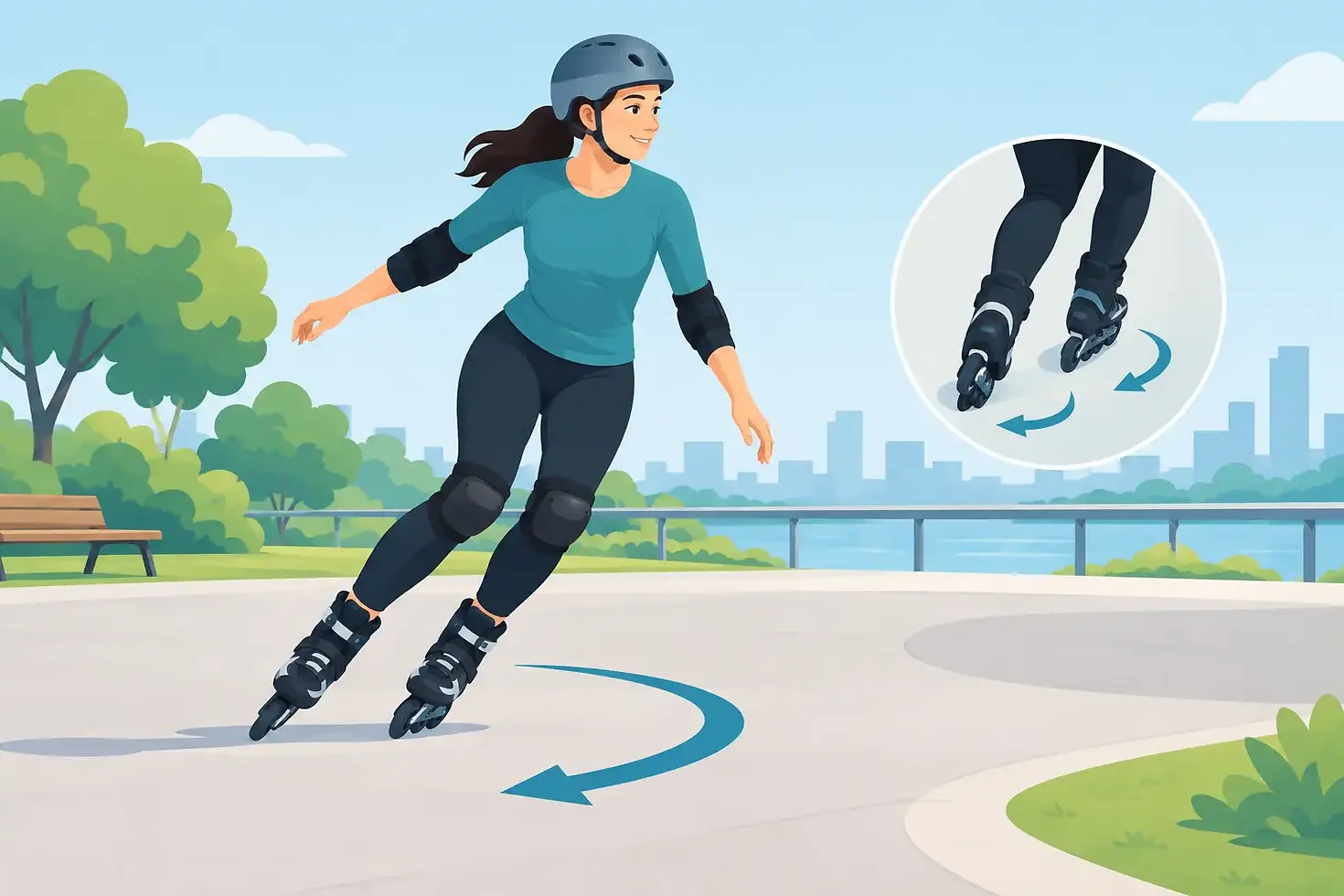
The safest first turn is a wide curve. Think of drawing a large letter C on the ground rather than trying to change direction sharply. Begin at a walking-speed roll on a flat surface.
First, bend your knees and place your arms comfortably in front of you. Look toward the open space where you want to finish the turn. Turn your head first, then allow your shoulders and hips to rotate gently in the same direction.
Next, shift a little more weight onto the outside skate. If you are turning left, your right skate is the outside skate. Keep both skates rolling and press lightly through the outside skate while allowing your body to lean slightly into the curve. The lean should come from your ankles and knees, not from bending at the waist.
Let the turn happen gradually. Do not force your skates to point sharply sideways. Maintain soft knees and use small adjustments in your arms to stay balanced. When you have completed the curve, return your head and shoulders to face forward, level your weight between both skates, and continue rolling.
Practice turns in both directions. Many skaters find one side more natural, but learning left and right turns early builds better balance and control. For younger children, cones, chalk circles, or safe visual markers can make this practice feel like a game while still developing real technique.
Use a scissor stance for more control
As your basic curves improve, use a scissor stance. This means one skate rolls slightly ahead of the other rather than staying perfectly side by side. It creates a longer, more stable base and makes it easier to steer.
For a left turn, place the left skate just a little ahead. For a right turn, place the right skate slightly ahead. The difference only needs to be small at first, about half a skate length. Keep your feet far enough apart that your wheels do not bump into each other.
The scissor stance is especially useful when you need to follow a curved path, avoid a stationary object, or prepare for a controlled stop. It is not a shortcut around learning balance. If your knees are straight or your weight is sitting behind your heels, the stance will feel unstable. Bend your knees and keep your body over the middle of your skates.
Move from curves to step turns
A step turn is a practical next skill for making a tighter turn at low speed. Instead of forcing your skates to carve a tight circle, you take small steps in the direction of the turn.
Start almost from a standstill. To turn left, look left and take a small step with your left skate toward the new direction. Bring the right skate around with a second small step. Continue with tiny, controlled steps until you are facing where you want to go. Reverse the movement to practice right turns.
Keep the steps short. Big steps can cause the wheels to catch, especially if your skates cross too early. At this stage, the goal is not speed or style. You are teaching your body to shift weight from one skate to the other while staying low and balanced.
Once this feels comfortable, try step turns while rolling very slowly. Many beginners rush this transition. It is better to repeat a smooth, controlled turn at low speed than to attempt a fast turn with stiff legs and poor stopping control.
Common mistakes that make turns difficult
Straight legs are the biggest problem. When knees are locked, your skates feel like they are moving separately from your body. Bend your knees before the turn starts and keep them bent until you are rolling straight again.
Another common mistake is rotating only the shoulders while the lower body stays frozen. Your head, shoulders, hips, knees, and skates should work together in a gentle sequence. Start with your eyes, then let the rest of your body follow naturally.
Some skaters lean too far into the turn because they are trying to make it sharper. A small lean is enough. If you feel your inside shoulder dropping toward the ground, bring your chest upright, bend your knees more, and make the curve wider.
Avoid turning on uneven pavement, near traffic, on wet surfaces, or down slopes while you are still learning. A simple turn becomes much more difficult when the ground is unpredictable. Choose a quiet, dry, open practice area where you can roll, turn, and stop without needing to react to other people.
Know when to slow down instead of turning
Turning is not always the safest answer. If you are moving too quickly toward another person, a wall, or the edge of a path, reduce speed first. A controlled braking skill gives you more options than a last-second sharp turn.
Beginners should learn a reliable stopping method alongside turning, such as a heel brake stop or a controlled plow stop. The right choice depends on your skate setup and current skill level. Practice stopping separately until it feels familiar, then combine a wide turn with a gentle stop.
For children, supervision makes a real difference. A coach can spot whether a child is leaning too far, looking down, or placing their feet too close together before those habits become harder to change. Small-group instruction also gives shy or cautious learners enough time to repeat the movement at a comfortable pace.
Practice a simple turning routine
Give yourself 10 to 15 minutes of focused practice rather than skating in circles without a goal. Roll forward and make five wide left curves, then five wide right curves. Next, practice slow scissor-stance curves in each direction. Finish with step turns from a near standstill.
Rest whenever your legs feel tired. Fatigue often causes beginners to straighten their knees and lose good posture. Short, regular sessions are more effective than one long session where technique breaks down.
At Affinity Skates, turning is taught as part of a structured progression, alongside balance, safe falling, stopping, and speed control. This helps beginners develop skills in the right order instead of attempting advanced movements before their foundation is ready.
Let control come before speed
A good turn should feel calm. You should be able to look where you are going, keep your knees bent, and finish with enough control to continue rolling or stop safely. If a turn feels rushed, make it wider, slow down, and return to the basics.
With patient practice, the moment that once felt wobbly becomes a useful everyday skill. Every smooth curve is proof that you are learning to trust your balance, read your space, and move with confidence on skates.


Comments